BEL060 – LOGISTICS BUILDING BOTANIC GARDEN
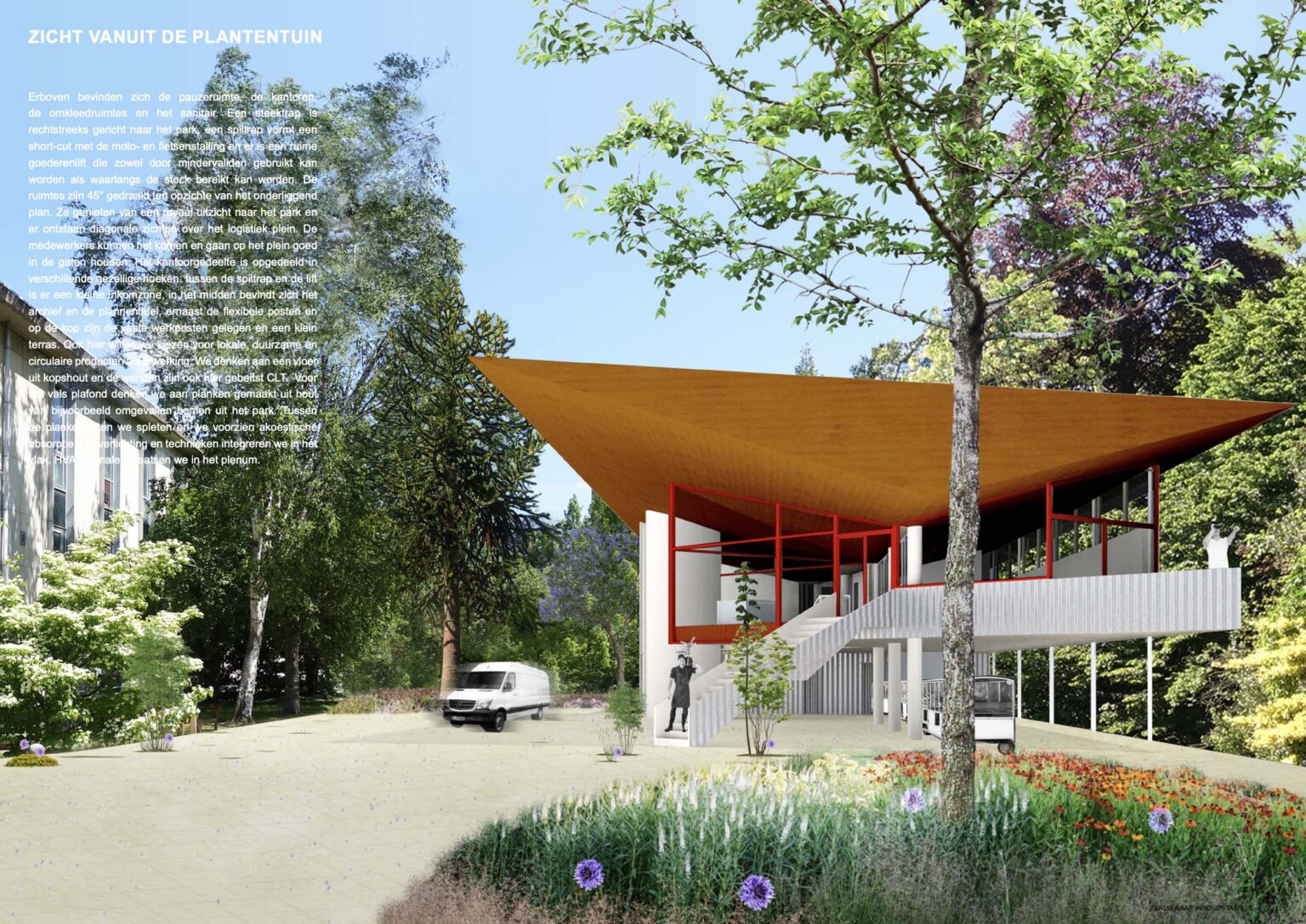
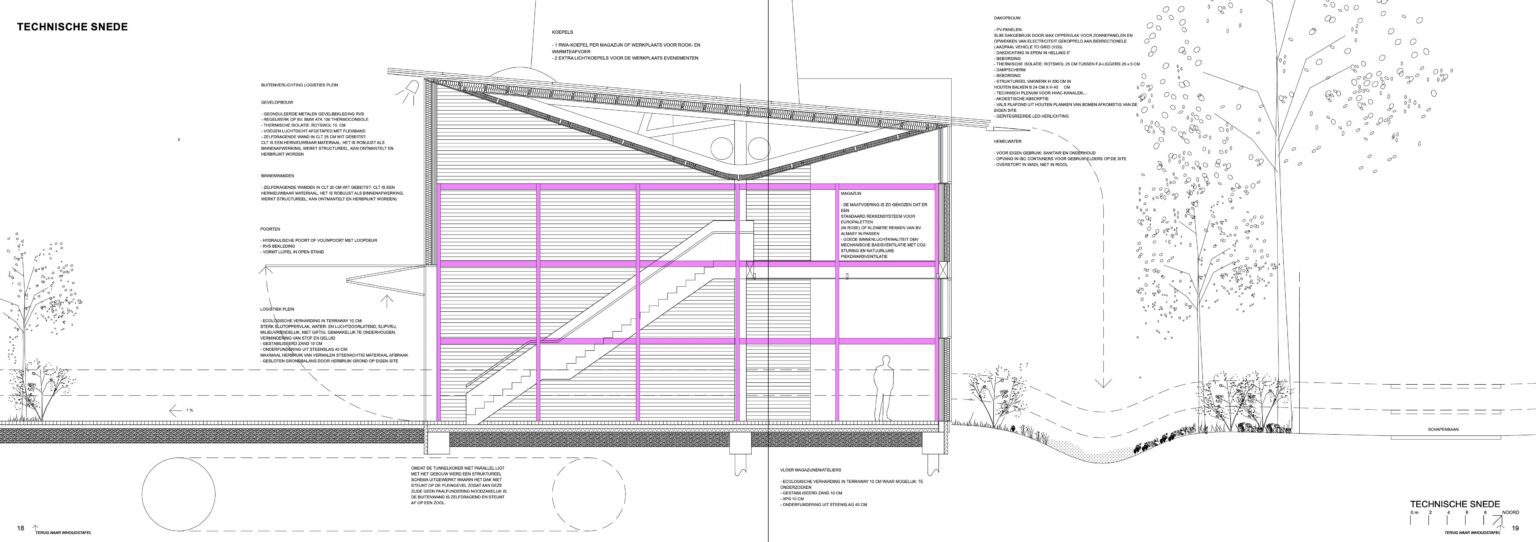
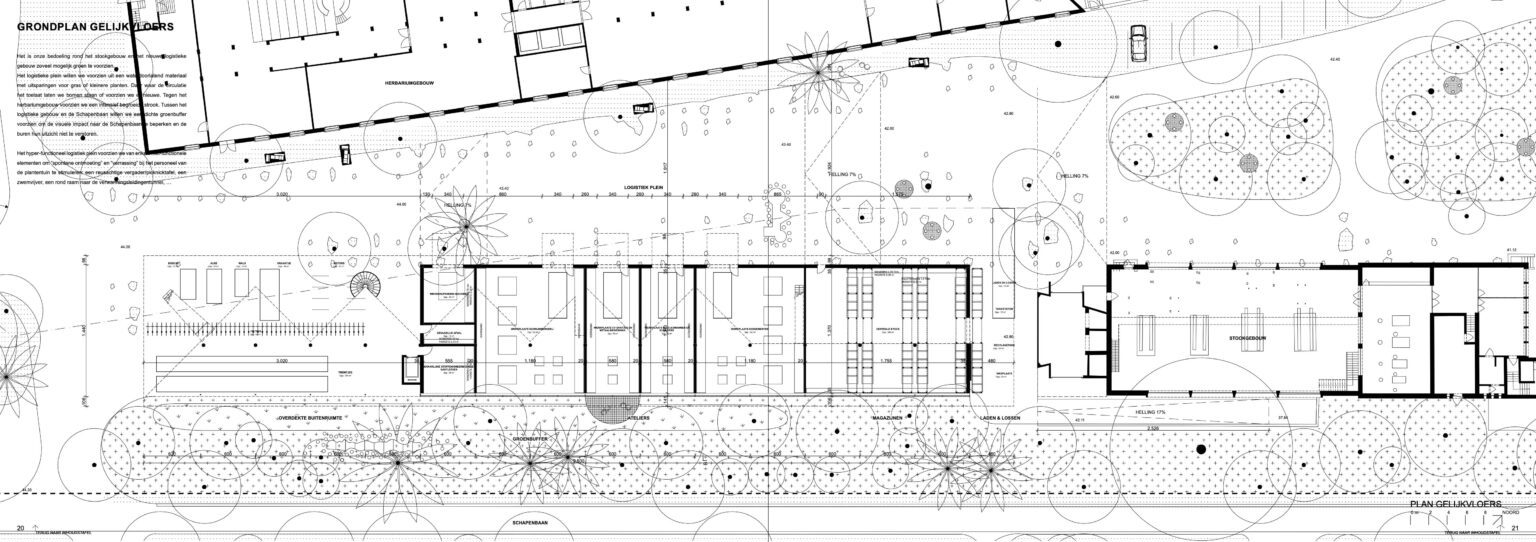
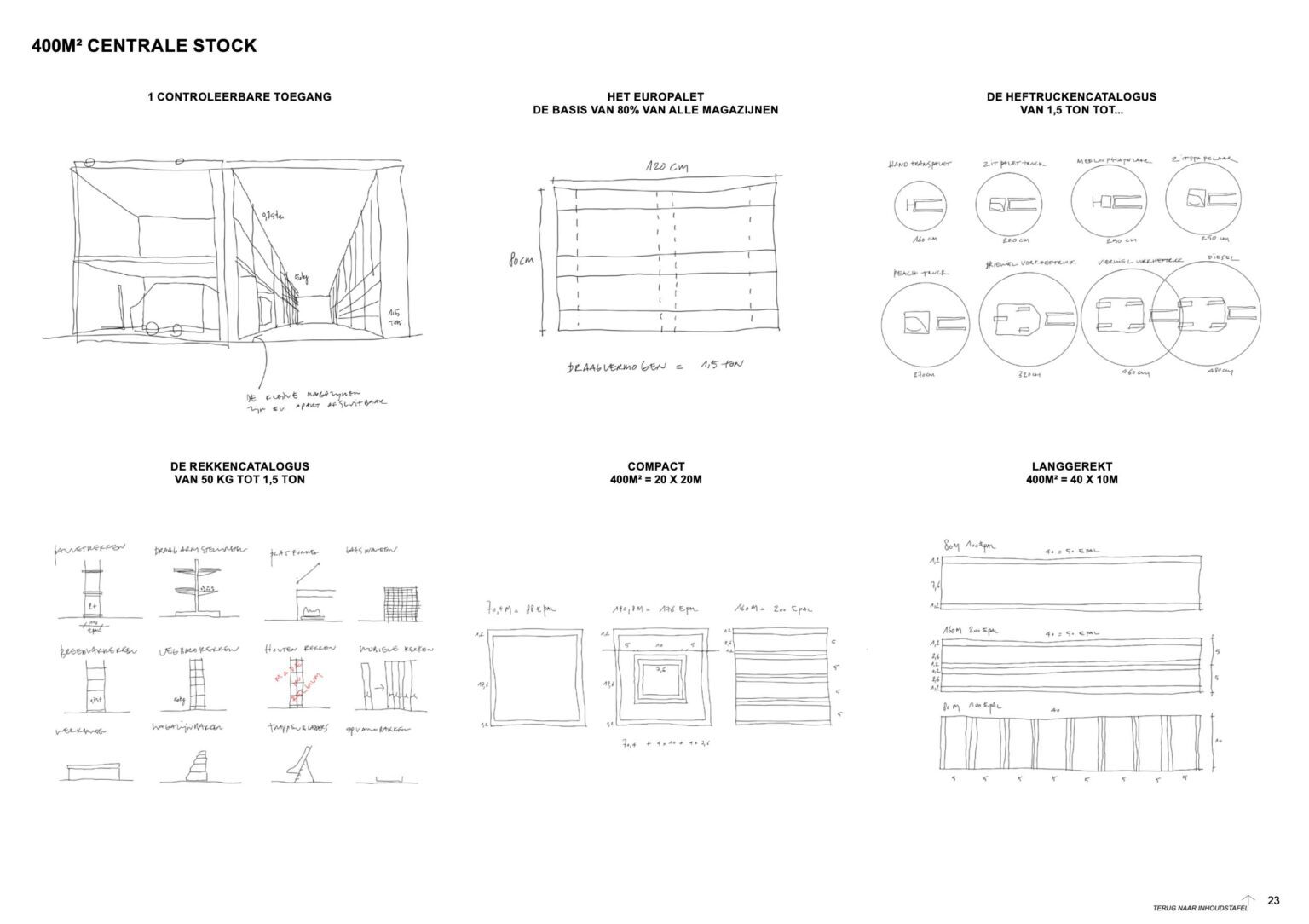
The ambition for the new logistics building, the renovation of the boiler house, and the logistics yard is to deliver a project that is simultaneously highly functional, sustainable, robust, and quietly elegant, all within the limits of the available budget. The proposal has already been tested in depth, down to a preliminary 1/50 detail section, and is conceived as a clear, coherent intervention that strengthens day-to-day operations while improving the spatial qualities of this part of the Botanic Garden.
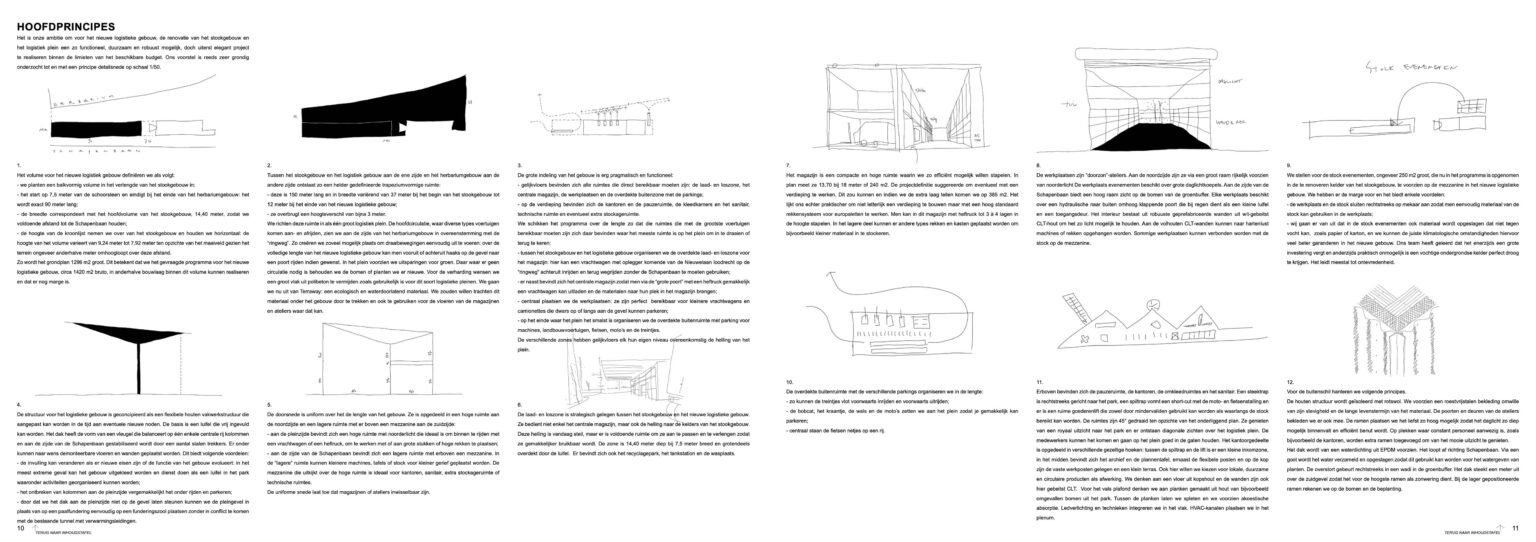
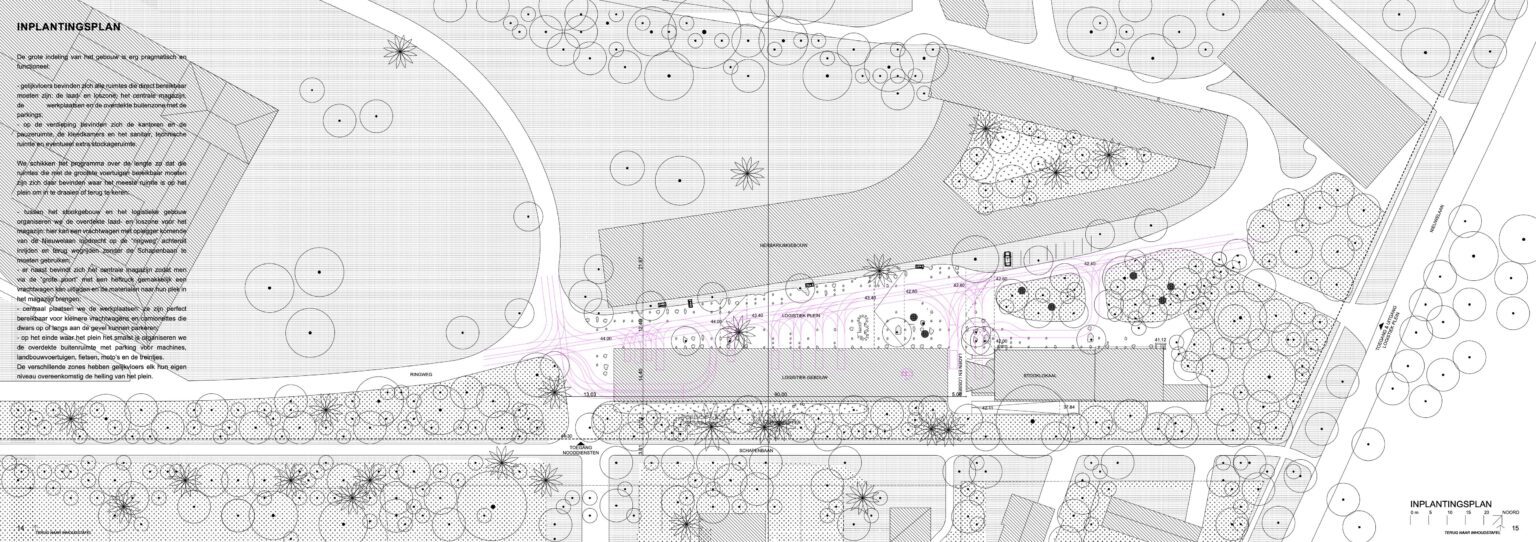
The new logistics building is defined as a long, bar-shaped volume aligned with the existing boiler house. It begins at a respectful distance from the chimney and runs precisely to the end of the herbarium building, forming a 90-metre-long structure whose width matches the boiler house at 14.40 metres. By adopting the boiler house’s eaves height and holding it as a continuous horizontal line, the building reads as a calm extension within the landscape, while its overall height subtly steps with the site’s natural rise. This simple geometry yields a footprint of 1,296 m², allowing the required gross programme of roughly 1,420 m² to fit comfortably across one and a half storeys, with flexibility in reserve.
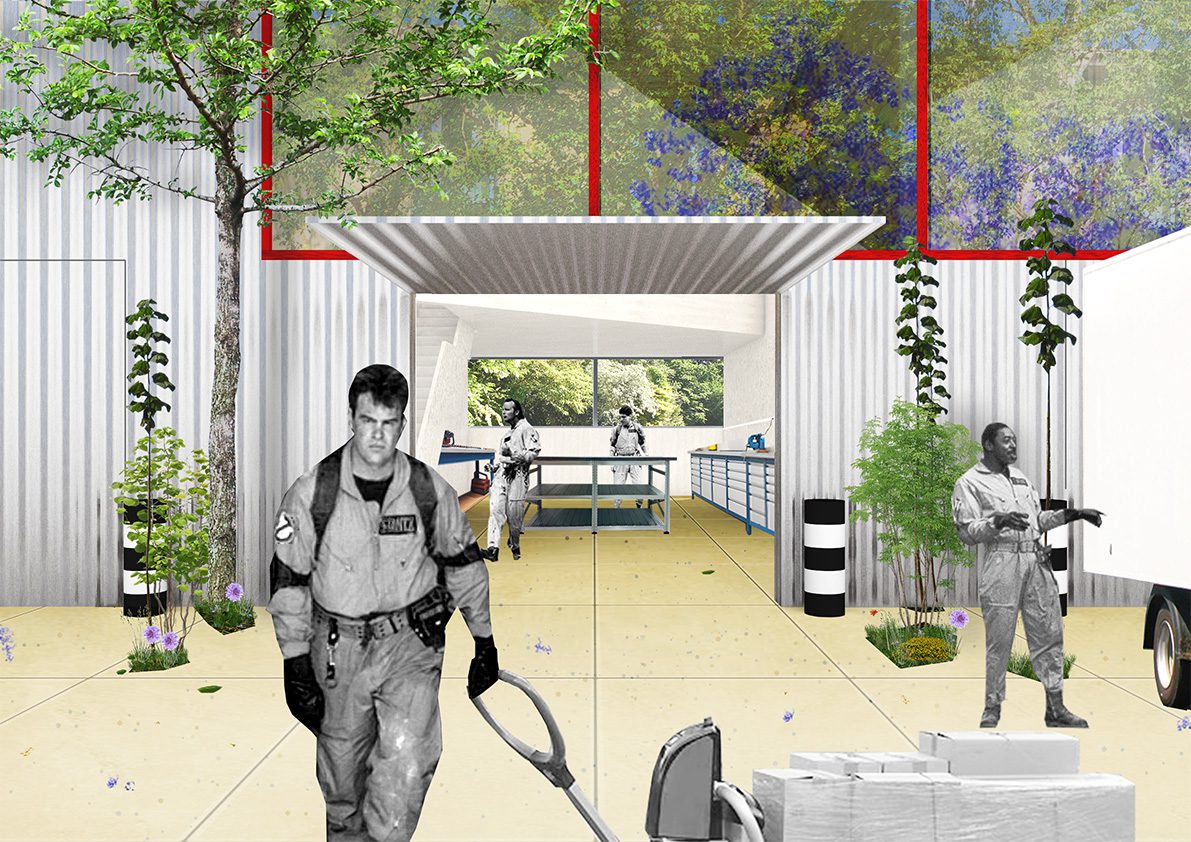
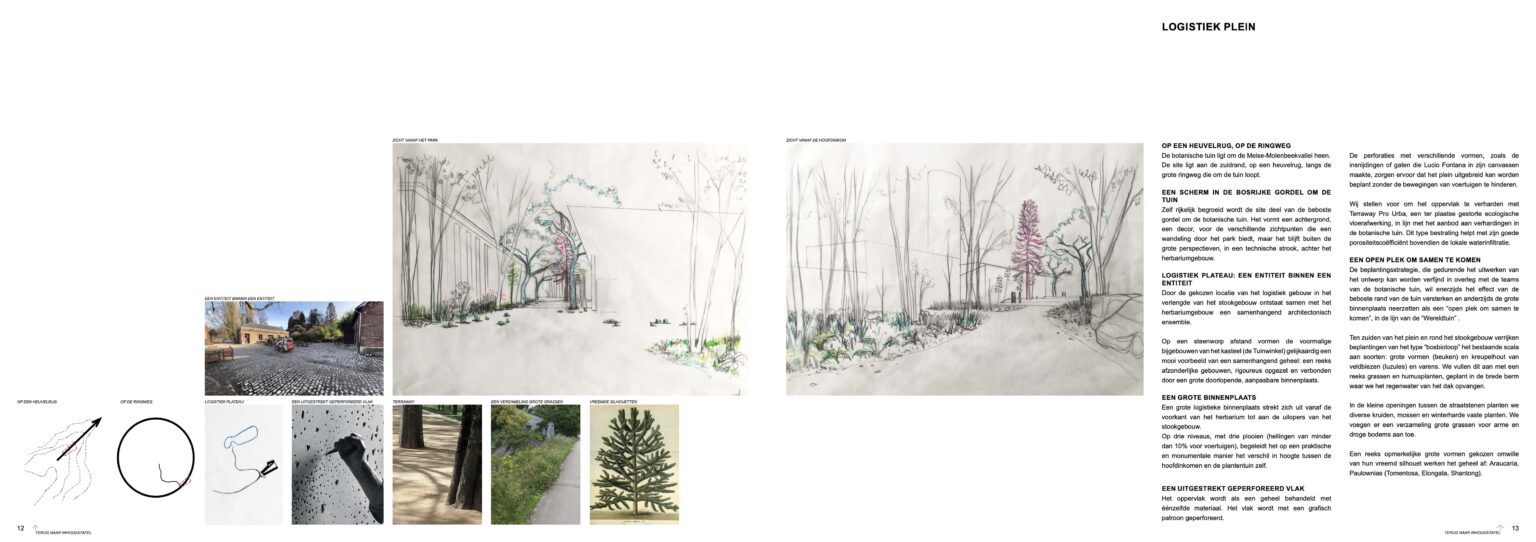
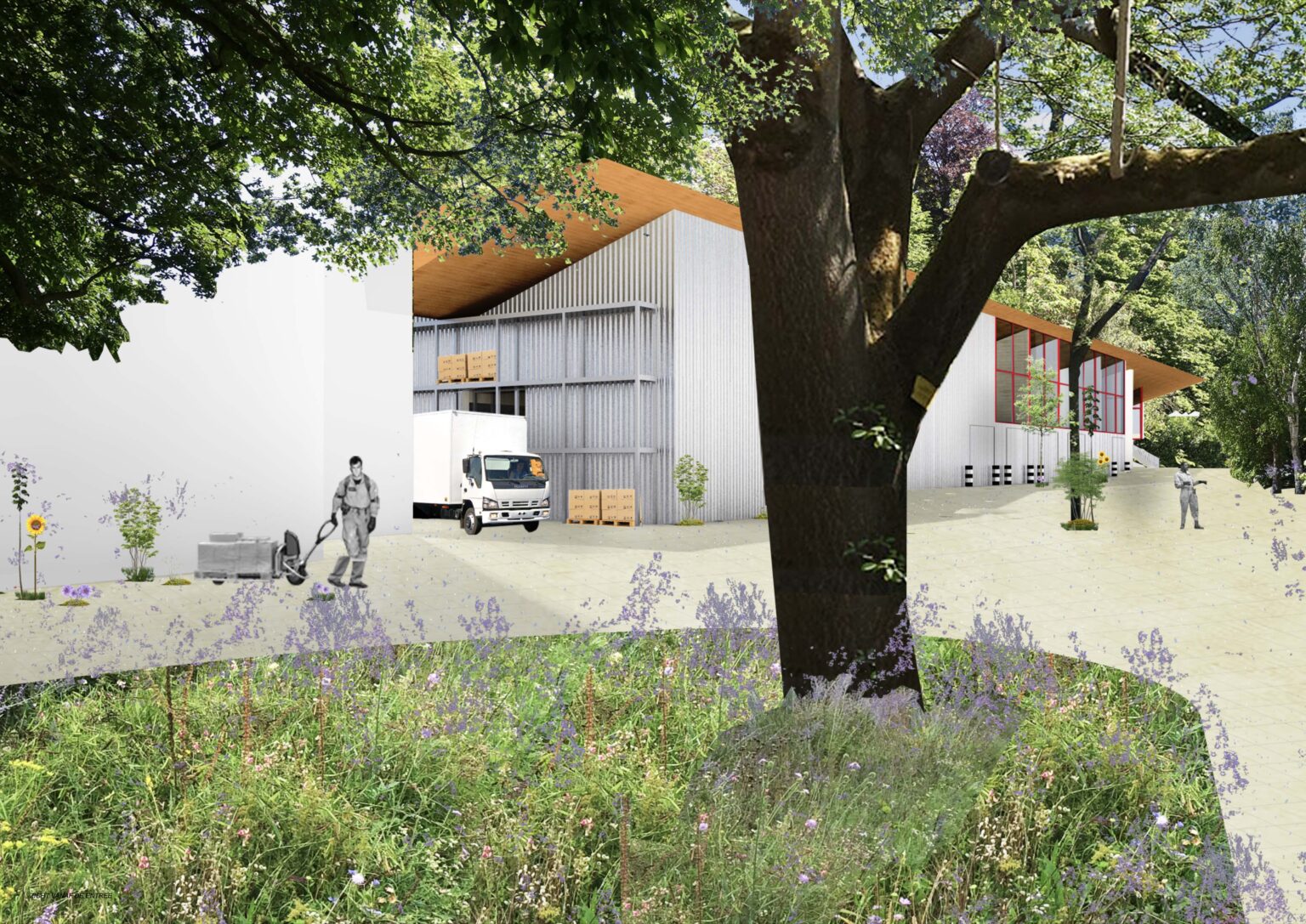
Between the boiler house and logistics building on one side, and the herbarium building on the other, this placement creates a sharply defined trapezoidal outdoor room measuring about 150 metres in length. Its width tapers from 37 metres to 12 metres and accommodates a height difference of nearly three metres, making it ideal for a single, generous logistics yard. Vehicle circulation is concentrated along the herbarium side, aligned with the ring road, so that the broadest turning space remains available for manoeuvres. Along the full length of the new façade, trucks and forklifts can approach gates directly, either forwards or reversing perpendicular to the building, without relying on the Schapenbaan. The yard is conceived not as a monotone engineered slab, but as a green-edged working landscape: pockets are left open for planting, existing trees are preserved where circulation allows, and new greenery is added elsewhere. The paving avoids the typical polibeton plane in favour of Terraway, an ecological, water-permeable surface that can be continued beneath the canopy and, where practical, inside workshops and storage areas.
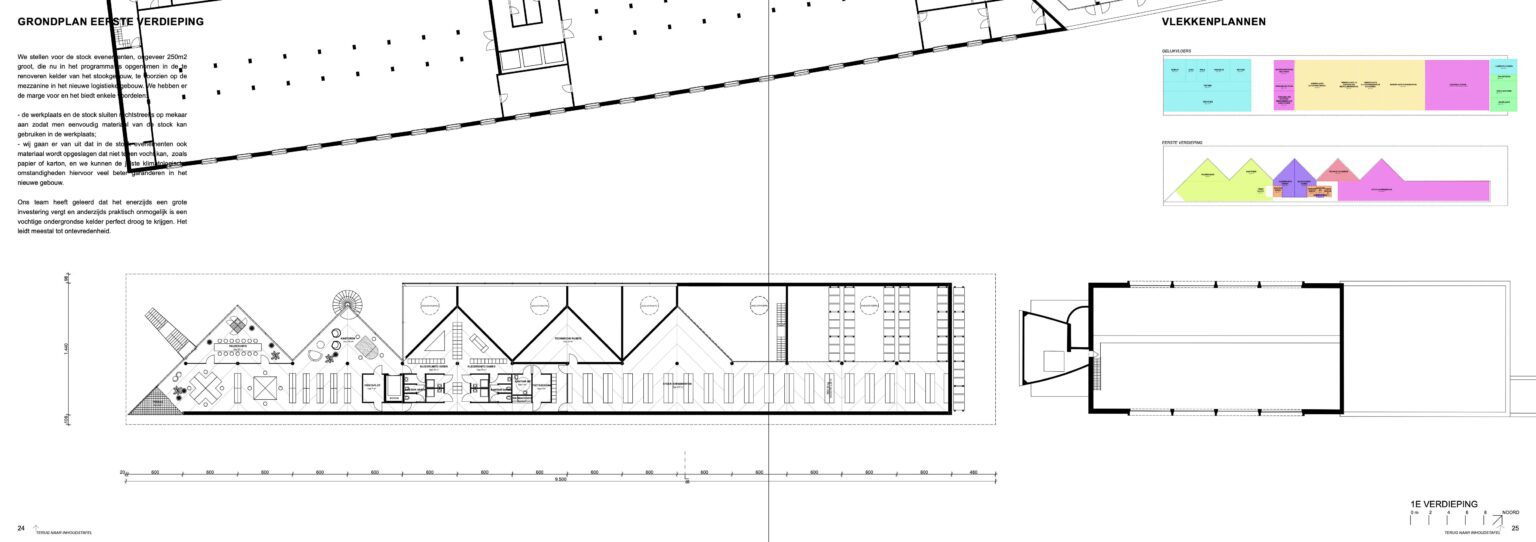
Inside the building, the layout follows practical logic. All spaces requiring direct access—loading and unloading, the central warehouse, workshops, and covered outdoor parking—are located on the ground floor. Offices, break spaces, changing rooms, sanitary facilities, technical rooms, and any additional storage sit above. The programme is distributed so that the largest vehicles reach the areas with the widest yard. The covered loading zone is positioned between the boiler house and the new building, enabling articulated trucks arriving from Nieuwelaan to reverse in and depart smoothly without using the Schapenbaan. The central warehouse sits immediately beside this zone for efficient forklift handling, while the workshops occupy the central stretch, accessible to smaller trucks and vans. At the narrowest end of the yard, a deep canopy shelters parking for machines, agricultural vehicles, bicycles, motorbikes, and the garden’s small trains. Ground-floor levels subtly step with the yard’s slope to keep thresholds easy and functional.
Structurally, the building is imagined as a flexible timber truss canopy whose infill can evolve over time. A wing-like roof balances on a single central row of columns and is stabilized toward the Schapenbaan by steel tie rods, leaving the yard side free of obstructions. Demountable floors and partitions can be inserted or removed as needs change; in an extreme future scenario, the building could even be stripped back to a simple park canopy for public use. This structural logic also allows the yard façade to sit on a straightforward strip foundation, avoiding conflicts with the existing heating-pipe tunnel.
A uniform cross-section runs the length of the building, with a tall, north-lit space facing the yard and a lower zone with a mezzanine toward the Schapenbaan. The high space welcomes trucks and forklifts, supports work on large items, and allows tall racking. The lower zone accommodates smaller equipment and storage, while the mezzanine overlooking the main hall provides an ideal platform for offices, sanitary facilities, technical rooms, or extra stock. The central warehouse itself is compact and lofty, designed for high-efficiency pallet racking rather than a fully constructed intermediate floor, enabling three to four stacking levels. Workshops are through-lit ateliers with abundant north light and generous views into the green buffer; large hydraulic doors open upward to form small rain canopies, and interiors are formed in white-stained CLT panels that remain bright, robust, and easy to adapt.
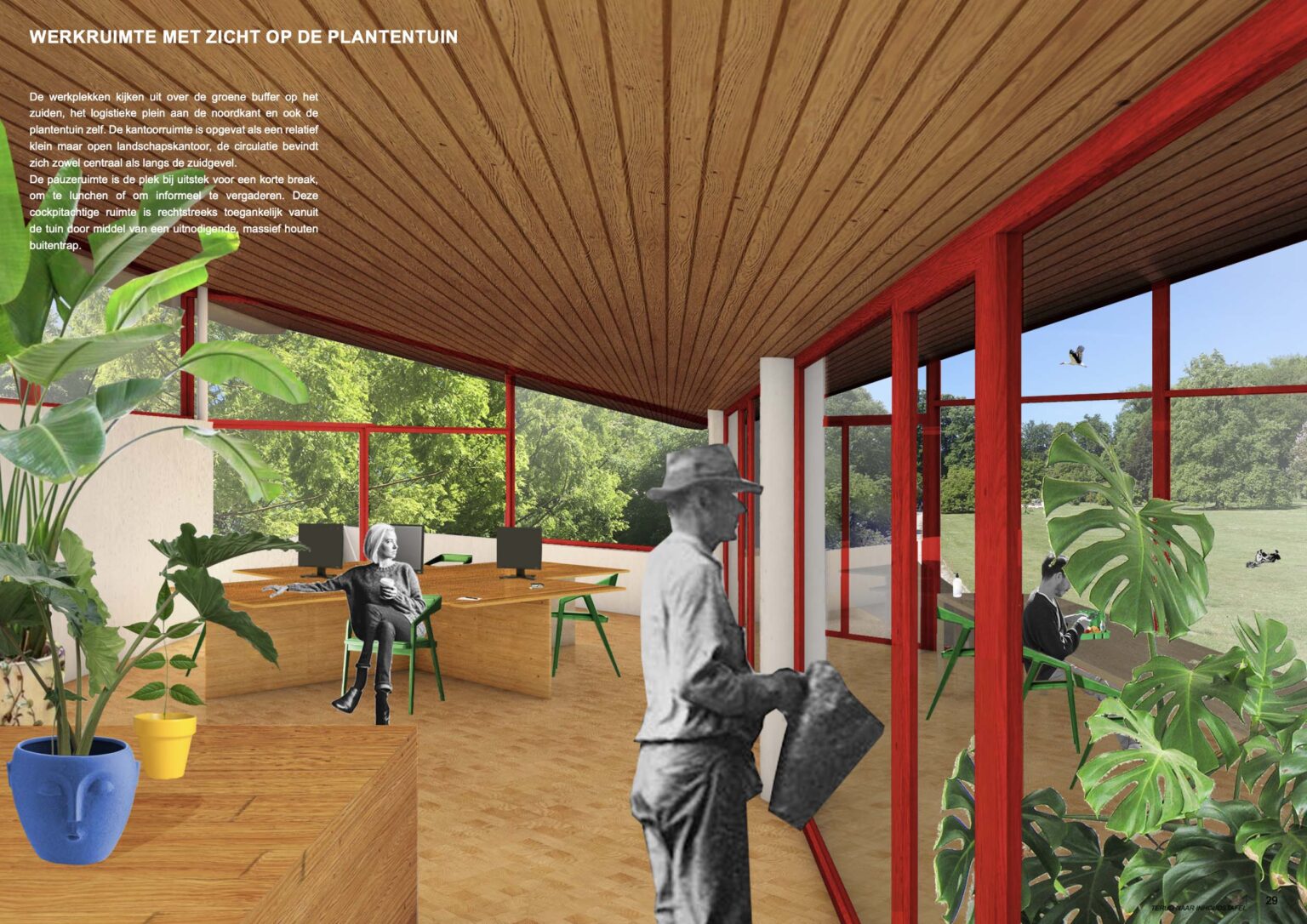
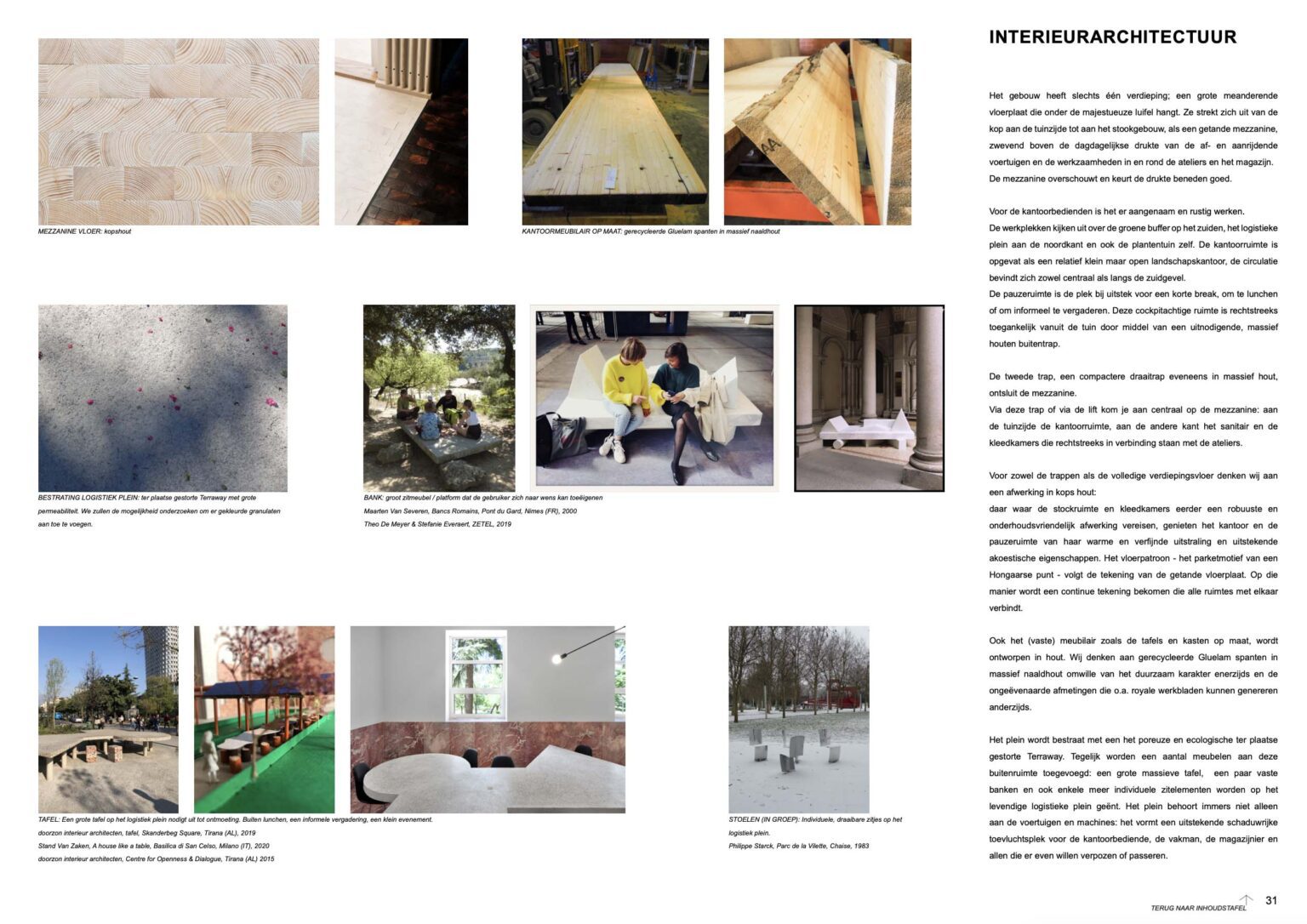
A key shift in the proposal is to relocate the event storage—around 250 m²—from the damp boiler-house basement to the mezzanine in the new building. This brings storage directly beside the workshops for faster workflows and ensures stable climatic conditions for moisture-sensitive material, avoiding the high cost and practical limits of drying subterranean spaces. Above, staff areas are rotated 45 degrees to capture wide park views and diagonal sightlines across the yard, allowing visual oversight of operations. The offices are arranged as a sequence of intimate work corners around stairs, lift, archive, and planning table, finished with local, durable, circular materials such as end-grain timber floors and CLT walls. A suspended ceiling made from reclaimed park wood integrates lighting, acoustics, and services with restraint.
The external envelope continues this logic of durability and care. Rock-wool insulation wraps the timber structure, while stainless-steel cladding gives a long-lasting, robust skin that also coats doors and gates. High window placement draws daylight deep inside, with additional openings where staff remain for extended periods. The EPDM roof drains toward the Schapenbaan into gutters that store rainwater for irrigation, with overflow directed to a wadi in the green buffer. A one-metre roof overhang shades the upper south windows; lower glazing is protected naturally by trees and planting. Finally, the logistics yard—though primarily a working surface—is enriched with a few deliberately “non-functional” elements to invite surprise and informal encounter among staff: a monumental picnic or meeting table, a swimming pond, and a circular window onto the heating-pipe tunnel, turning a purely operational place into a quietly humane one.